Triclosan
AKA “3380-34-5, 5-CHLORO-2-(2, 4-DICHLOROPHENOXY)PHENOL, Cloxifenolum, 2, 4, 4'-Trichloro-2'-hydroxydiphenyl ether, Triclosanum, Irgasan DP300, Stri-Dex Cleansing Bar, Stri-Dex Face Wash, CH 3565”
Synthetic
Ingredient Facts
Triclosan
AKA: 3380-34-5, 5-CHLORO-2-(2, 4-DICHLOROPHENOXY)PHENOL, Cloxifenolum, 2, 4, 4'-Trichloro-2'-hydroxydiphenyl ether, Triclosanum, Irgasan DP300, Stri-Dex Cleansing Bar, Stri-Dex Face Wash, CH 3565
Synthetic · Skin Conditioning · EWG: 7
Synthetic
Skin Conditioner
Synthetic
Not Clean
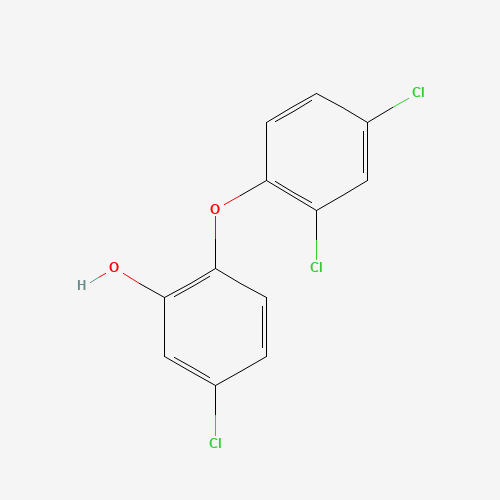
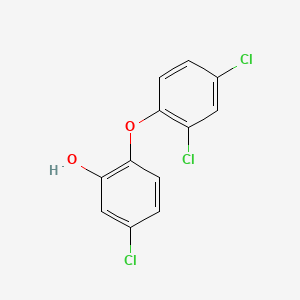
Triclosan is an aromatic ether that is phenol which is substituted at C-5 by a chloro group and at C-2 by a 2,4-dichlorophenoxy group. It is widely used as a preservative and antimicrobial agent in personal care products such as soaps, skin creams, toothpaste and deodorants as well as in household items such as plastic chopping boards, sports equipment and shoes. It has a role as an EC 1.3.1.9 [enoyl-[acyl-carrier-protein] reductase (NADH)] inhibitor, a fungicide, an antibacterial agent, a xenobiotic, an antimalarial, an EC 1.5.1.3 (dihydrofolate reductase) inhibitor, a persistent organic pollutant and a drug allergen. It is a dichlorobenzene, a member of phenols, an aromatic ether and a member of monochlorobenzenes.
Solubility In water, 10 mg/L at 20 °C
Formula
C12H7Cl3O2
Mol. Weight
289.50
CAS #
3380-34-5
State
White to off-white crystalline powder; [HSDB]
See origin →
Functions
Skin Conditioning
A catch-all term for ingredients that improve how skin looks and feels — softer, smoother, more supple. The workhorse behind most moisturizers.
Fights Bacteria
Controls Odor
Preserves Formula
Neutralizes odor
Prevents microbial growth
Traditional Use
This is the CAS number for Ascorbyl Palmitate, a stabilized form of Vitamin C developed in the mid-20th century. Created to improve the shelf-stability of vitamin C in skincare formulations while maintaining antioxidant properties.
Skin Types
●all-skin-types
Best For
General
EWG
7
CIR
Insufficient
Pregnancy
—
Restricted By
CIR Safety Findings
Not a Sensitizer
all-shades-safe
Concentration Guide
0.15%
0%0%
Reg. Limit
EU/SCCS limit: 0.15% in cosmetic products. Opinion: SCCS/1414/11
Regulatory Agencies
Final Report: Safety Assessment of Triclosan as a Used in Cosmetics
Cosmetic Ingredient Review (CIR) Expert Panel
International Journal of Toxicology
Triclosan Environmental Exposure and Toxicity
Dann AB, Hontela A
Journal of Applied Toxicology, 2011
Triclosan
Environmental Working Group (EWG)
EWG Skin Deep Cosmetics Database
Triclosan
Health Canada
Health Canada Cosmetic Ingredient Hotlist
Clinical preliminary evaluation of PEG-80 sorbitan laurate (Novisol) versus sodium C14-16 olefin sulfonate & triclosan (Septisol) in deep-peeling Hett
Kass LG, Rullan PP, Brody HJ
Journal of the American Academy of Dermatology, 2020
Clinical preliminary evaluation of PEG-80 sorbitan laurate (Novisol) versus sodium C14-16 olefin sulfonate & triclosan (Septisol) in deep-peeling Hett
Kass LG, Rullan PP, Brody HJ
Journal of the American Academy of Dermatology, 2020
Safety of Triclocarban and Triclosan as substances with potential endocrine disrupting properties in cosmetic products
Scientific Committee on Consumer Safety (SCCS)
European Commission — SCCS
Triclosan exposure, transformation, and human health effects.
Weatherly LM, Gosse JA
Journal of toxicology and environmental health. Part B, Critical reviews, 2017
Verified Jun 2026
Data: PubChem · CosIng · EWG · CIR