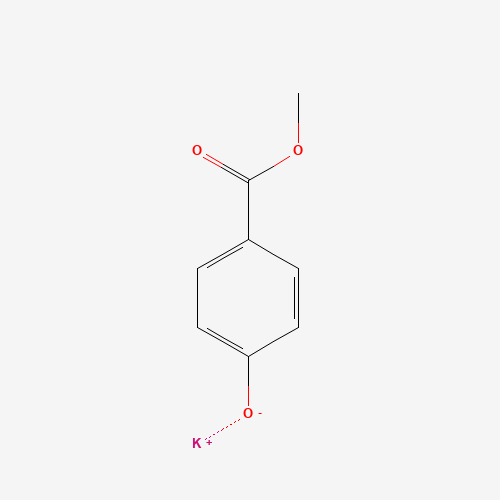

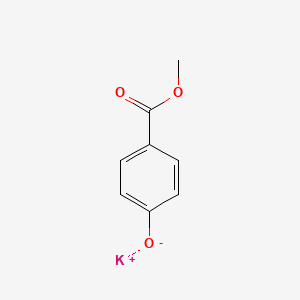
Potassium Methylparaben
AKA “26112-07-2, UNII-M64U971IB0, M64U971IB0, EINECS 247-464-2, Methylparaben, potassium salt, Benzoic acid, 4-hydroxy-, methyl ester, 4-Hydroxybenzoic acid, METHYL P-HYDROXYBENZOATE POTASSIUM SALT, METHYL 4-HYDROXYBENZOATE POTASSIUM SALT”
Preservative
Ingredient Facts
Potassium methylparaben
AKA: 26112-07-2, UNII-M64U971IB0, M64U971IB0, EINECS 247-464-2, Potassium salt, Benzoic acid, 4-hydroxy-, Methyl ester, 4-Hydroxybenzoic acid, METHYL P-HYDROXYBENZOATE POTASSIUM SALT, METHYL 4-HYDROXYBENZOATE POTASSIUM SALT
Preservative · Preservative · EWG: 4
Synthetic
Preservative
Not Clean
Potassium methyl 4-oxidobenzoate
Formula
C8H7KO3
Mol. Weight
190.24
CAS #
26112-07-2
Form
Powder
See origin →
Functions
Preservative
Keeps your product from growing bacteria, mold, or yeast. Without these, that jar of cream becomes a petri dish in about a week.
Preserves Formula
Prevents microbial growth
Traditional Use
The potassium salt form of methylparaben, a synthetic preservative developed in the early 20th century as a replacement for mercury-based and other toxic preservatives in cosmetics.
Skin Types
●all-skin-types
Best For
General
Pregnancy & Breastfeeding Safe
Caution
EWG
4
CIR
Safe as used
Pregnancy
Caution
Restricted By
CIR Safety Findings
medical-approval
all-shades-safe
Phototoxicity Concern
Concentration Guide
8.0%
0%11%
Reg. Limit
EU regulatory limit: 8.0%. 0,4% (as acid) for single ester 0,8% (as acid) for mixtures of esters Source: EU Cosmetics Regulation (EC) 1223/2009, Annex V (Preservatives), Entry 12. Dermal absorption: 0.1%. Source: CIR Safety Assessment (CIR Seq 746).
Regulatory Agencies
Final amended report on the safety assessment of Methylparaben, Ethylparaben, Propylparaben, Isopropylparaben, Butylparaben, Isobutylparaben, and Benz
International journal of toxicology, 2008
Final amended report on the safety assessment of Methylparaben, Ethylparaben, Propylparaben, Isopropylparaben, Butylparaben, Isobutylparaben, and Benz
International journal of toxicology, 2008
Final amended report on the safety assessment of Methylparaben, Ethylparaben, Propylparaben, Isopropylparaben, Butylparaben, Isobutylparaben, and Benz
International journal of toxicology, 2008
RIFM fragrance ingredient safety assessment, pentanedioic acid, 1,5-dimethyl ester, CAS Registry Number 1119-40-0.
Api AM, Belsito D, Botelho D, Browne D, Bruze M et al.
Food and chemical toxicology : an international journal published for the British Industrial Biological Research Association, 2018
Benzyl Alcohol, Benzoic Acid, Sodium Benzoate
Cosmetic Ingredient Review (CIR) Expert Panel
International Journal of Toxicology
Final Amended Report on the Safety Assessment of Methylparaben, Ethylparaben, Propylparaben, Isopropylparaben, Butylparaben, Isobutylparaben and Benzylparaben as used in cosmetic products
Cosmetic Ingredient Review (CIR) Expert Panel
International Journal of Toxicology
Final Report on the Safety Assessment of Benzyl Alcohol, Benzoic Acid, and Sodium Benzoate
Cosmetic Ingredient Review (CIR) Expert Panel
International Journal of Toxicology
Final Report on the Safety Assessment of Methylparaben, Ethylparaben, Propylparaben, and Butylparaben
Cosmetic Ingredient Review (CIR) Expert Panel
International Journal of Toxicology
Safety Assessment of Benzyl Alcohol, Benzoic Acid and its Salts, and Benzyl Benzoate
Cosmetic Ingredient Review (CIR) Expert Panel
International Journal of Toxicology
4-Hydroxybenzoic acid rescues multisystemic disease and perinatal lethality in a mouse model of mitochondrial disease.
Corral-Sarasa J, Martínez-Gálvez JM, González-García P, Wendling O, Jiménez-Sánchez L et al.
Cell reports, 2024
4-Hydroxybenzoic Acid
European Commission
EU Cosmetic Ingredient Database (CosIng)
Methylparaben
European Commission
EU Cosmetic Ingredient Database (CosIng)
Potassium Methylparaben
European Commission
EU Cosmetic Ingredient Database (CosIng)
Sodium Methylparaben
European Commission
EU Cosmetic Ingredient Database (CosIng)
Benzoic acid and its derivatives as naturally occurring compounds in foods and as additives: Uses, exposure, and controversy.
Del Olmo A, Calzada J, Nuñez M
Critical reviews in food science and nutrition, 2017
Benzoic acid and its derivatives as naturally occurring compounds in foods and as additives: Uses, exposure, and controversy.
Del Olmo A, Calzada J, Nuñez M
Critical reviews in food science and nutrition, 2017
Benzoic acid and its derivatives as naturally occurring compounds in foods and as additives: Uses, exposure, and controversy.
Del Olmo A, Calzada J, Nuñez M
Critical reviews in food science and nutrition, 2017
4-Hydroxybenzoic Acid
Environmental Working Group (EWG)
EWG Skin Deep Cosmetics Database
Benzoic Acid
Environmental Working Group (EWG)
EWG Skin Deep Cosmetics Database
Methylparaben
Environmental Working Group (EWG)
EWG Skin Deep Cosmetics Database
Toluidines, their isomers, salts and halogenated and sulfonated derivatives except 4-hydroxy-2-nitro-toluidine and hydroxyethyl-2-nitro-p-toluidine
Health Canada
Health Canada Cosmetic Ingredient Hotlist
Synthesis of mixed esters of ascorbic acid using methyl esters of palm and soybean oils.
Hsieh HJ, Chen JW, Giridhar R, Wu WT
Preparative biochemistry & biotechnology, 2005
Safety Assessment of Benzyl Alcohol, Benzoic Acid and its...
Wilbur Johnson, Wilma F Bergfeld, Donald V Belsito, Ronald A Hill, Curtis D Klaassen, Daniel C Liebler + 5 more
International journal of toxicology, 2017
Safety Assessment of Benzyl Alcohol, Benzoic Acid and its...
Wilbur Johnson, Wilma F Bergfeld, Donald V Belsito, Ronald A Hill, Curtis D Klaassen, Daniel C Liebler + 5 more
International journal of toxicology, 2017
Sensory irritation to methylparaben is caused by its low metabolism in the skin.
Ninomiya R, Nishijima T, Aoshima M, Sakaguchi H, Tokura Y
The Journal of dermatology, 2023
Analytical Method for the Identification and Assay of Kojic Acid, Methylparaben, and Propylparaben in Cosmetic Products Using UPLC: Application of ISO
Qadir MA, Ahmed M, Shafiq MI, Ali A, Sadiq A
Journal of AOAC International, 2016
Verified Jun 2026
Data: PubChem · CosIng · EWG · CIR