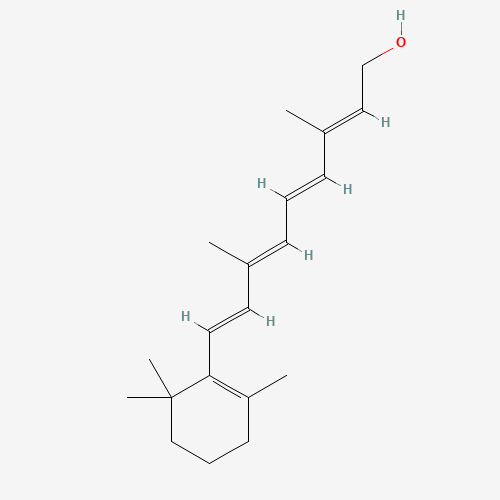
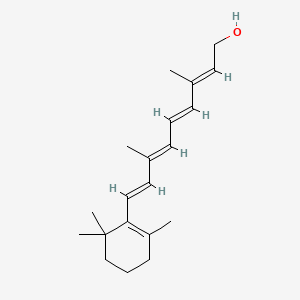
Retinol
AKA “all-trans-Retinol, 68-26-8, trans-retinol, Veroftal, Agoncal, Bentavit A, Homagenets Aoral, Sehkraft A, Testavol S”
Skin Conditioning
Ingredient Facts
Retinol
AKA: All-trans-Retinol, 68-26-8, Trans-retinol, Veroftal, Agoncal, Bentavit A, Homagenets Aoral, Sehkraft A, Testavol S
Skin Conditioning · Miscellaneous · EWG: 4
Synthetic
Skin Conditioner
Retinoid
Not Clean
Vitamin A (retinol) is a yellow fat-soluble, antioxidant vitamin important in vision and bone growth. It belongs to the family of chemical compounds known as retinoids. Retinol is ingested in a precursor form; animal sources (milk and eggs) contain retinyl esters, whereas plants (carrots, spinach) contain pro-vitamin A carotenoids. Hydrolysis of retinyl esters results in retinol while pro-vitamin A carotenoids can be cleaved to produce retinal. Retinal, also known as retinaldehyde, can be reversibly reduced to produce retinol or it can be irreversibly oxidized to produce retinoic acid. Retinol and derivatives of retinol that play an essential role in metabolic functioning of the retina, the growth of and differentiation of epithelial tissue, the growth of bone, reproduction, and the immune response. Dietary vitamin A is derived from a variety of carotenoids found in plants. It is enriched in the liver, egg yolks, and the fat component of dairy products.
Solubility Practically insoluble (NTP, 1992)
Formula
C20H30O
Mol. Weight
286.50
CAS #
68-26-8, 11103-57-4
Form
Oil
State
Vitamin a appears as yellow crystals or orange solid. Practically water insoluble. (NTP, 1992)
Pairs Well With
See origin →
Functions
Skin Conditioning
A catch-all term for ingredients that improve how skin looks and feels — softer, smoother, more supple. The workhorse behind most moisturizers.
Miscellaneous
Boosts collagen production
Reduces fine lines
Supports cell turnover
Evens pigmentation
Smooths skin texture
Traditional Use
Vitamin A was identified in 1913; retinol's anti-aging properties were discovered in the 1980s when researchers studying acne treatments noticed significant improvements in skin texture and wrinkles.
Skin Types
●all-skin-types
Best For
Wrinkles
Pregnancy & Breastfeeding Safe
No
EWG
4
CIR
Safe as used
Pregnancy
No
CIR Safety Findings
medical-approval
all-shades-safe
Phototoxicity Concern
Use Caution With
Regulatory Agencies
Novel Cyclized Hexapeptide-9 Outperforms Retinol Against Skin Aging: A Randomized, Double-Blinded, Active- and Vehicle-Controlled Clinical Trial.
Chang H, Tao K, Yang Y, Wang Y, Ge M et al.
Journal of cosmetic dermatology, 2025
Final Report on the Safety Assessment of Retinyl Palmitate and Retinol
Cosmetic Ingredient Review (CIR) Expert Panel
International Journal of Toxicology
Retinol
European Commission
EU Cosmetic Ingredient Database (CosIng)
Retinol (Vitamin A)
European Commission
EU Cosmetic Ingredient Database (CosIng)
Prospective, randomized, double-blind assessment of topical bakuchiol and retinol for facial photoageing.
Dhaliwal S, Rybak I, Ellis SR, Notay M, Trivedi M et al.
The British journal of dermatology, 2019
Retinol (Vitamin A)
Environmental Working Group (EWG)
EWG Skin Deep Cosmetics Database
Mitigation of retinol-induced skin irritation by physiologic lipids: Evidence from patch testing.
Fang Y, Ying Y, Xiaolan W, Lin S, Chenlan X et al.
Journal of cosmetic dermatology, 2024
Retinol and its esters
Health Canada
Health Canada Cosmetic Ingredient Hotlist
Improvement of naturally aged skin with vitamin A (retinol).
Kafi R, Kwak HS, Schumacher WE, Cho S, Hanft VN et al.
Archives of dermatology, 2007
Tensile properties and contours of aging facial skin. A controlled double-blind comparative study of the effects of retinol, melibiose-lactose and the
Piérard-Franchimont C, Castelli D, Cromphaut IV, Bertin C, Ries G et al.
Skin research and technology : official journal of International Society for Bioengineering and the Skin (ISBS) [and] International Society for Digital Imaging of Skin (ISDIS) [and] International Society for Skin Imaging (ISSI), 1998
Human Skin Aging and the Anti-Aging Properties of Retinol.
Quan T
Biomolecules, 2023
Retinol Wrinkle Reduction Clinical Trial
Randhawa M, Wang S, Leyden JJ, Cula GO, Pagnoni A, Southall MD
Dermatologic Surgery, 2015
Revision of the scientific Opinion (SCCS/1576/16) on Vitamin A (Retinol, Retinyl Acetate, Retinyl Palmitate)
Scientific Committee on Consumer Safety (SCCS)
European Commission — SCCS
Chitosan/β-glucan/cystine multifunctional hydrogel loading retinol liposomes for efficiently treating UV-induced skin damage and aging.
Song Q, Wang Y, Tan Z, Xiang H, Liu Q et al.
Carbohydrate polymers, 2026
Verified Jun 2026
Data: PubChem · CosIng · EWG · CIR